Skip to content
Headless ShopifyHeadless Shopify

THEFUTUREOFJEWELRY

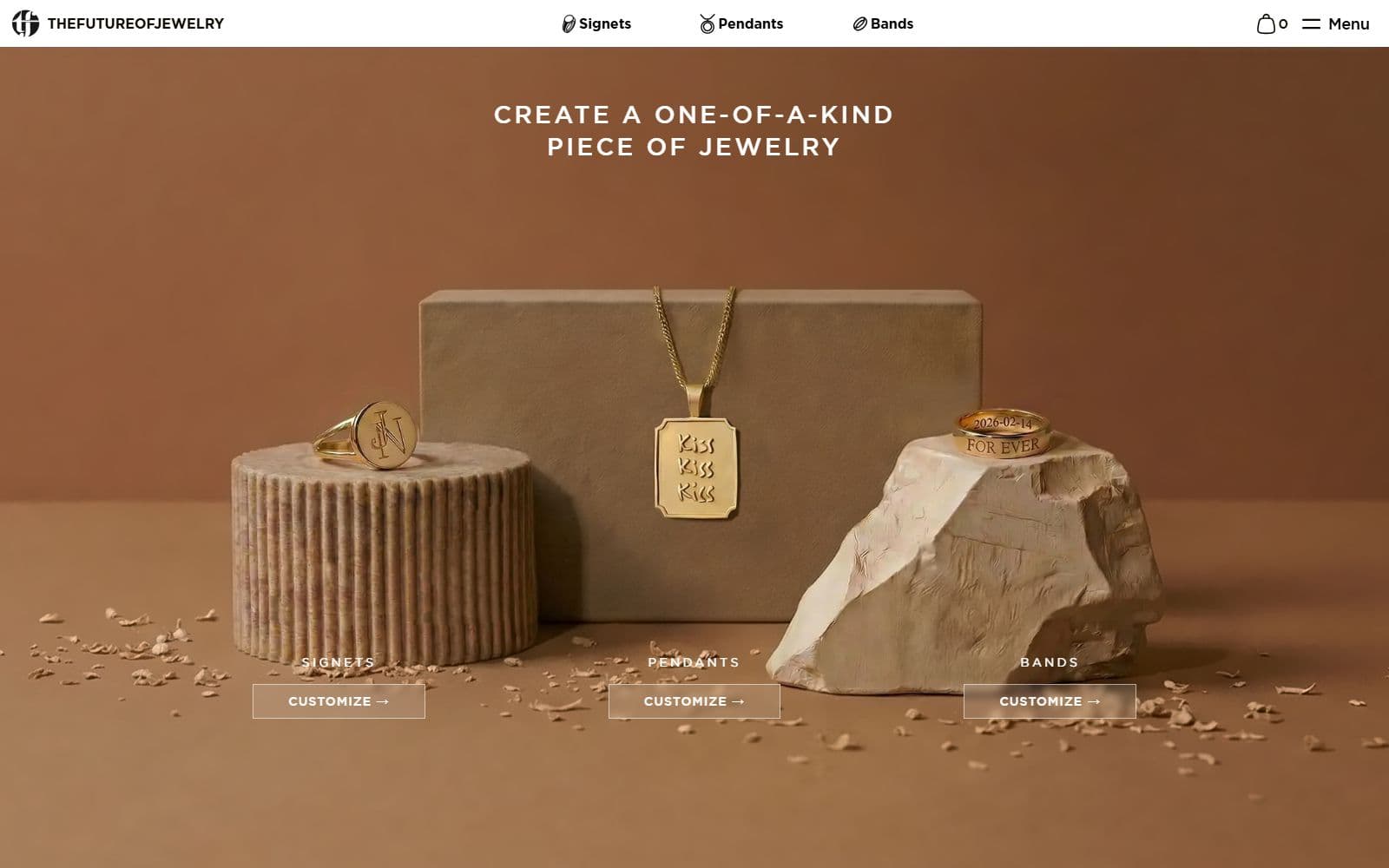
Every ring on this store is designed by the customer before it exists, so the product page had to become a configurator rather than a gallery.

THEFUTUREOFJEWELRY: the live site
Our role
Full build: 3D configurator, storefront and Shopify integration
Timeline
14 weeks to launch
Team
Lead engineer, two frontend engineers, product designer

3D

In-browser configurator

real time, no plugin

3

Customisable ranges

signets, pendants, bands

6

Options per piece

face, border, band, material, design, size

01

The problem

A made-to-order product does not fit a product page

The brand sells signet rings, pendants and bands that are made to order. A customer picks the face shape, the border, the band profile, the metal, the engraving and the size, and the piece is manufactured afterwards. That is not a variant matrix a normal Shopify product page can hold, and it is certainly not something a customer can imagine from a photo.

Selling it needs the customer to see their exact piece before they buy, which means rendering the combination live rather than photographing every permutation.

02

What we did

A configurator app, with Shopify kept behind it

The configurator is its own React application, mounted at the customizer routes and built separately from the rest of the site. It renders the selected combination in 3D, updates the price as options change, and hands the finished specification to the cart.

The marketing and content pages are a separate static build, so the pages that need to be fast and crawlable are not carrying the configurator's bundle. Only customers who reach the customizer download it.

Shopify stays underneath as the commerce layer. Checkout, orders and payment are Shopify's problem, which is the correct division: the interesting work here is the configuration, and none of that is a good reason to rebuild a checkout.

  • React configurator with live 3D preview and per-option pricing
  • Static marketing pages built separately, so they do not carry the app bundle
  • Configured specification passed through to the cart as line-item detail
  • Checkout left entirely to Shopify
03

The outcome

The product sells itself once you can spin it

Customers can now assemble a piece, rotate it, and see the engraving on the face before adding it to the cart. That removes the single biggest objection to buying made-to-order jewelry online, which is not knowing what will arrive.

What it is built on

Frontend

  • React
  • Vite
  • Astro
  • 3D rendering

Commerce

  • Shopify
  • Headless storefront
  • Shopify checkout

What we learned

  • 01

    Made-to-order products need a configurator, not a variant list. The moment options multiply past a few dozen combinations, photography stops being an option.

  • 02

    Splitting the marketing build from the application build keeps the pages that need SEO and speed away from the bundle that needs features.

  • 03

    Headless is worth it when the product experience genuinely cannot be built in a theme. This is that case.

Next step

Tell us what you are trying to build.

Thirty minutes with the engineer who would lead the project. You will leave with an opinion on what to build, what to skip, and roughly what it costs, whether or not you hire us.

2 build slots open · Next start: early next month

What happens next

  1. 1You send a few lines about the product and the deadline
  2. 2We reply within one working day with times
  3. 3A 30-minute call, no deck, no sales script
  4. 4A written summary and a ballpark range within 48 hours